
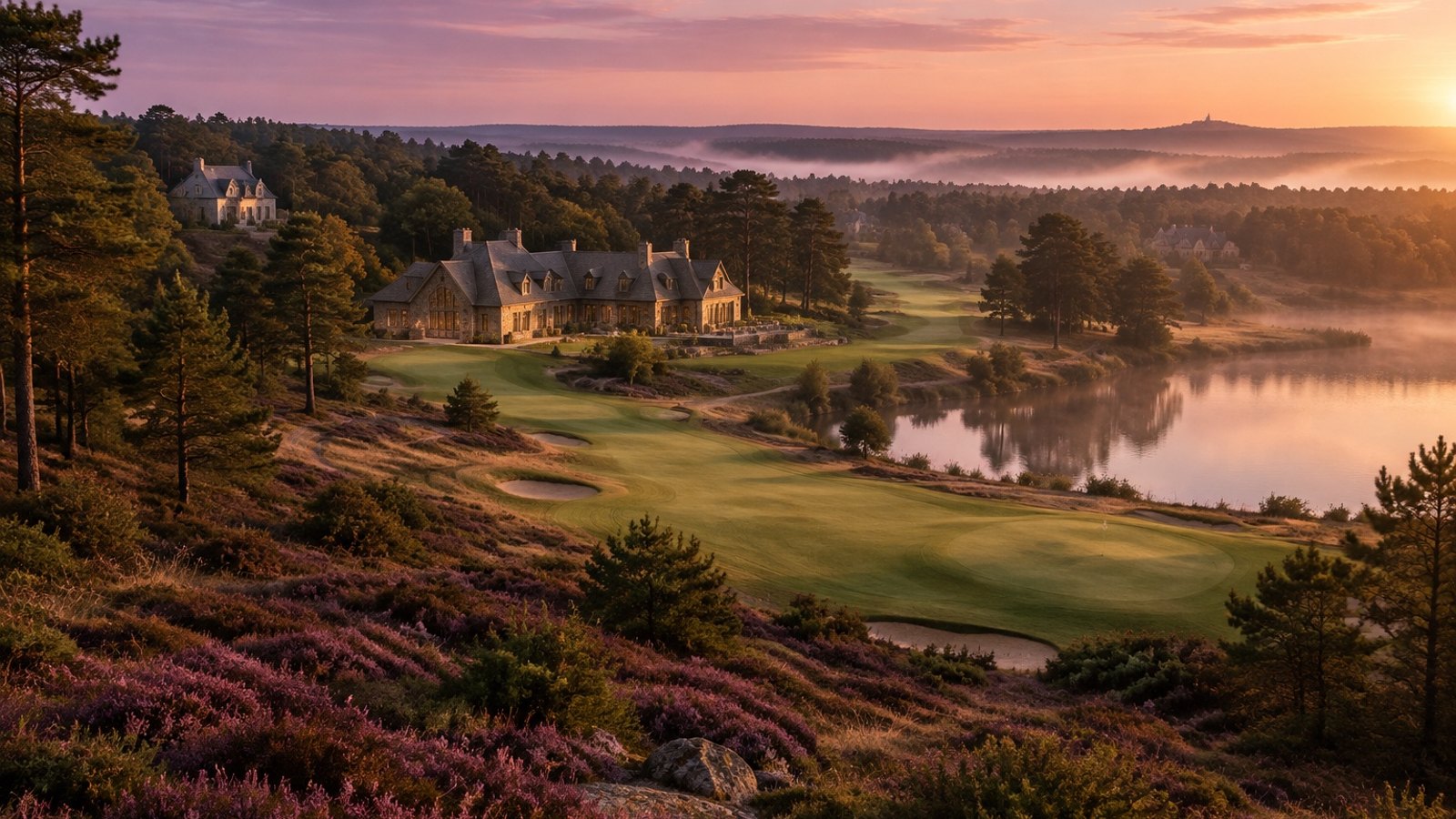
IT for a private golf estate in France is closer to running a small town than running a clubhouse. One estate can combine a members golf club, private residences, a hotel and spa, restaurants, a gatehouse and a greenkeeping operation, spread over hundreds of hectares of forest and heathland. This 2026 guide is written for estate directors, club managers, finance heads and owners' representatives at private members golf estates in France.
Key takeaways
- A golf estate runs four technology worlds at once: the club, the residences, hospitality and the course itself. They share one network and one set of member and owner data.
- Distance is the defining problem. Copper network cable is limited to about 100 metres, so an estate needs its own fibre backbone between buildings.
- Member, owner and guest records, camera footage and gate logs are personal data under the GDPR, and a breach that puts people at risk must be reported to the CNIL within 72 hours.
- Irrigation, pump stations and gates are operational systems that must be kept apart from guest Wi-Fi and office computers.
- Fully managed IT support for an estate typically falls in the range of €80 to €180 per user per month in 2026, with the network itself costed as a separate project.
The short version
A private golf estate needs one accountable IT partner that treats the property as a single campus. That partner keeps the club, residences, hospitality and course systems working over a private fibre network, protects member and owner privacy under the GDPR, and stays reachable on weekends and through the summer season. The individual systems are standard. The difficulty is scale, distance, weather and the number of different people who expect the estate to feel effortless.
What a French private golf estate looks like
France has a small group of estates that combine private membership golf with homes and hospitality. The typical model covers several hundred hectares of forest or heathland within a few hours of Paris or in the south, and offers one or two championship courses alongside private residences, leisure facilities such as an equestrian centre, and a hotel and spa.
Terre Blanche in Provence is one public example, with a hotel, two courses and private villas. Clubs such as Morfontaine, north of Paris, are private golf clubs without the residential estate. The guidance below applies most to the first kind, where golf, homes and hotel share one property. BroadVision has no commercial relationship with any estate named here; they are cited as public examples.
The four technology worlds on one estate
| Area | Typical systems | What IT must guarantee |
|---|---|---|
| Members club | Membership and billing, tee sheet, pro shop and restaurant point of sale (for example Jonas Club Software or Albatros) | Accurate member accounts, role-based access, backup |
| Residences | Owner portal, home internet, smart-home and security systems, rental programme | Privacy between homes, reliable service, a clear support boundary |
| Hospitality | Hotel property management, spa and restaurant bookings, guest Wi-Fi | Card payment security, integration with the club account |
| Course and grounds | Irrigation central control and pump stations, weather and lightning sensors, cart fleet GPS, maintenance yard | Isolation from guest and office networks, monitoring |
| Estate security | Gatehouse, number plate recognition, cameras, access control | Secured storage, retention limits, restricted viewing rights |
| Back office | Email, accounts, payroll, files (typically Microsoft 365) | Multi-factor authentication, device management, backup |
How an estate differs from a city club
| Dimension | City members club | Private golf estate |
|---|---|---|
| Footprint | One building | Dozens of buildings across hundreds of hectares |
| Network | Cabling within floors | Private fibre between clubhouse, gatehouse, yard, hotel and homes |
| People on the network | Members, guests, staff | Members, guests, staff, home owners, their families and contractors |
| Busiest period | Evenings | Weekends, tournaments and the summer season |
| Operational technology | Door control | Irrigation, pumps, gates, cart fleet, sensors |
| Main outage risk | Internet circuit | Lightning, power, cable damage from groundworks |
Connectivity across the estate
Standard copper network cable carries data about 100 metres. A golf estate measures its distances in kilometres, so every building needs to be joined by fibre. The sound design is a ring: fibre leaves the main equipment room, passes each building and returns by a different route, so a single cut by a digger does not take anything offline.
Three French and rural specifics matter:
- The copper telephone network is closing. Orange is retiring France's copper network in stages, with full closure planned by 2030. Any gatehouse, pump station or outbuilding still on a DSL or analogue line needs a migration plan.
- Two ways out. The estate should have two internet connections that do not share a route, for example fibre from one operator and a second service by a different path, with satellite or mobile data as a last resort.
- Lightning and power. Outdoor equipment needs surge protection and fibre rather than copper between buildings, because copper carries a lightning surge from one building to the next.
For outdoor Wi-Fi, note the rules on the 6 GHz band. The European Union harmonised the lower 6 GHz band (5,945 to 6,425 MHz) for Wi-Fi in June 2021, but standard-power use is limited to indoors. Terraces, practice areas and the course still rely on the 2.4 and 5 GHz bands, so outdoor coverage needs its own survey. See Connectivity & Infrastructure.
Keeping course systems apart
Modern greenkeeping is run from software. Irrigation central control systems such as Toro Lynx or Rain Bird schedule every sprinkler head and talk to pump stations and weather sensors. Carts report their position by GPS. Gates and barriers are opened by number plate cameras.
These are operational systems, and they were not designed to sit on the same network as guest phones. They should run on their own segments, with remote access for suppliers that is logged, time-limited and protected by multi-factor authentication. The test is simple: a visitor on the terrace Wi-Fi should have no route at all to a pump controller or a gate.
GDPR, the CNIL and member privacy
Privacy is a large part of what a private estate sells. Under the General Data Protection Regulation the estate is the controller, and every supplier that handles its data is a processor. The French regulator is the CNIL.
- Article 32 requires appropriate technical and organisational security, such as multi-factor authentication, role-based access and encrypted devices.
- Article 28 requires a written contract with each processor, including the IT provider and each software vendor.
- Article 33 requires a breach to be reported to the CNIL within 72 hours of the estate becoming aware of it, unless it is unlikely to put people at risk.
- Article 9 treats biometric data used to identify a person as a special category, so fingerprint or facial recognition at a gate needs a strong justification and careful design.
- Video surveillance. The CNIL expects clear signage, restricted viewing rights and limited retention, which in most cases means no more than one month. Number plates read at the gate are personal data too.
An estate holds an unusual combination: who is a member, who owns which home, who is in residence this week and who their guests are. Access to that picture should be limited to the few people who need it, and every export should be logged.
What IT support costs an estate
These are indicative planning ranges for 2026, excluding VAT, licences, hardware and project work. They are estimates based on European managed service pricing, and an estate's real cost depends heavily on its size and on how much on-site presence it needs.
| Item | Indicative price | Notes |
|---|---|---|
| Essential managed support | €45 to €80 per user per month | Service desk, patching, backup monitoring |
| Fully managed support | €80 to €180 per user per month | Adds security tooling, Microsoft 365 administration and reporting |
| Network and Wi-Fi monitoring | Priced per device or per site | Switches, access points, links, operational segments |
| Fibre backbone and Wi-Fi build | Project, quoted after survey | The largest single cost, ideally coordinated with groundworks |
| IT leadership | Priced per committed day | Roadmap, budgets, supplier and vendor management |
An estate with 60 named staff users on fully managed support would pay roughly €4,800 to €10,800 per month. Residents' home systems are normally outside that figure and are either supported under a separate owner service or left to the owner's own installer. Decide which, and write it down.
Remote support and time zones
Much of an estate's IT work, including the service desk, monitoring, security and system administration, can be done remotely. South Africa suits French hours well: it is on UTC+2 all year, which is the same time as France in summer and one hour ahead in winter, so a South African team works the estate's full day.
Three conditions apply. South Africa is not covered by an EU adequacy decision, so the contract must include the European Commission's standard contractual clauses under Article 46. Ask which languages the service desk covers, because staff may prefer support in French while management and an international membership work in English. And cabling, hardware and survey work need hands on site, so name the local contractor in the agreement.
What to ask an IT provider
- Have you designed and supported a multi-building campus network, and can we see one?
- How will you separate guest, staff, payment, resident and course systems?
- What cover do we get on weekends, during tournaments and in August?
- Will you sign a GDPR processor agreement, and which transfer mechanism covers support delivered from outside the EU?
- Where does our support stop and a home owner's own responsibility begin?
- Who holds our administrator passwords and network documentation, and how do we get them back if we part ways?
How BroadVision helps
BroadVision works with hospitality operators on networking, Wi-Fi, AV and hospitality IT systems, and has supported South African and UK clients from its Johannesburg hub for over two decades, a model it also offers to estates in France. For a private golf estate, that means campus network design and monitoring under Connectivity & Infrastructure, day-to-day support and security under Managed IT Services, and a technology roadmap and vendor governance through Strategic IT Services. Where an estate wants one view of rounds played, spend per member, occupancy and course data, BiVi brings it together. For city clubs, see our guides for London and New York. For the wider picture, read our complete guide to hospitality IT. To discuss your estate, contact BroadVision.
FAQ
What IT does a private golf estate need?
A private golf estate needs a private fibre network joining every building, segmented Wi-Fi, and six groups of systems: club membership and tee sheet, residences, hotel and restaurant, course and grounds, estate security, and a back office that usually runs on Microsoft 365. The systems must share member and owner accounts while staying separated on the network, so that guest devices cannot reach payment, security or irrigation equipment. One provider should document how they connect. BroadVision designs and supports that kind of campus under Connectivity & Infrastructure.
How much does IT support cost for a golf estate in France?
As a planning range, fully managed IT support costs about €80 to €180 per user per month in 2026, excluding VAT, licences, hardware and projects, and essential cover about €45 to €80. An estate with 60 named staff users would pay roughly €4,800 to €10,800 per month. The fibre backbone and Wi-Fi build is a separate project quoted after a survey, and is usually the largest cost. These are estimates, not quotes. BroadVision scopes the estate first and prices against that scope. See Managed IT Services.
How do you get reliable Wi-Fi and internet across a large estate?
Start with fibre between buildings, laid as a ring so that one cable cut does not cause an outage, because copper network cable only reaches about 100 metres. Add two internet connections that do not share a route, with satellite or mobile data as a last resort, and surge protection on outdoor equipment. Outdoor Wi-Fi needs its own survey, since standard-power 6 GHz use in Europe is limited to indoors. BroadVision designs, installs and monitors these networks under Connectivity & Infrastructure.
Does the GDPR apply to a private members golf club?
Yes. Member, owner and guest records, camera footage, gate logs and number plates are personal data under the GDPR, whatever the club's private status. The estate is the controller. Article 28 requires a written contract with each processor, Article 32 requires appropriate security, and Article 33 requires a report to the CNIL within 72 hours of a breach that puts people at risk. Camera footage should normally be kept for no more than one month. BroadVision signs a GDPR processor agreement before onboarding. See Strategic IT Services.
Should irrigation and gate systems be on the same network as guests?
No. Irrigation central control, pump stations, gate barriers and cameras are operational systems that were not built to withstand traffic from visitors' phones and laptops. They should run on their own network segments, with supplier remote access that is logged, time-limited and protected by multi-factor authentication. A guest on the terrace Wi-Fi should have no route to a pump controller. This separation also limits the damage if one system is compromised. BroadVision builds and monitors that segmentation as part of Connectivity & Infrastructure.
Can a French estate's IT be supported from South Africa?
Yes, for the service desk, monitoring, security and administration. South Africa is on UTC+2 all year, the same time as France in summer and one hour ahead in winter, so the team works the estate's full day. Because South Africa has no EU adequacy decision, the contract must include standard contractual clauses under Article 46 of the GDPR, and on-site work needs a named local contractor. Confirm language cover as well. BroadVision has supported UK clients from Johannesburg for over two decades. See Managed IT Services.